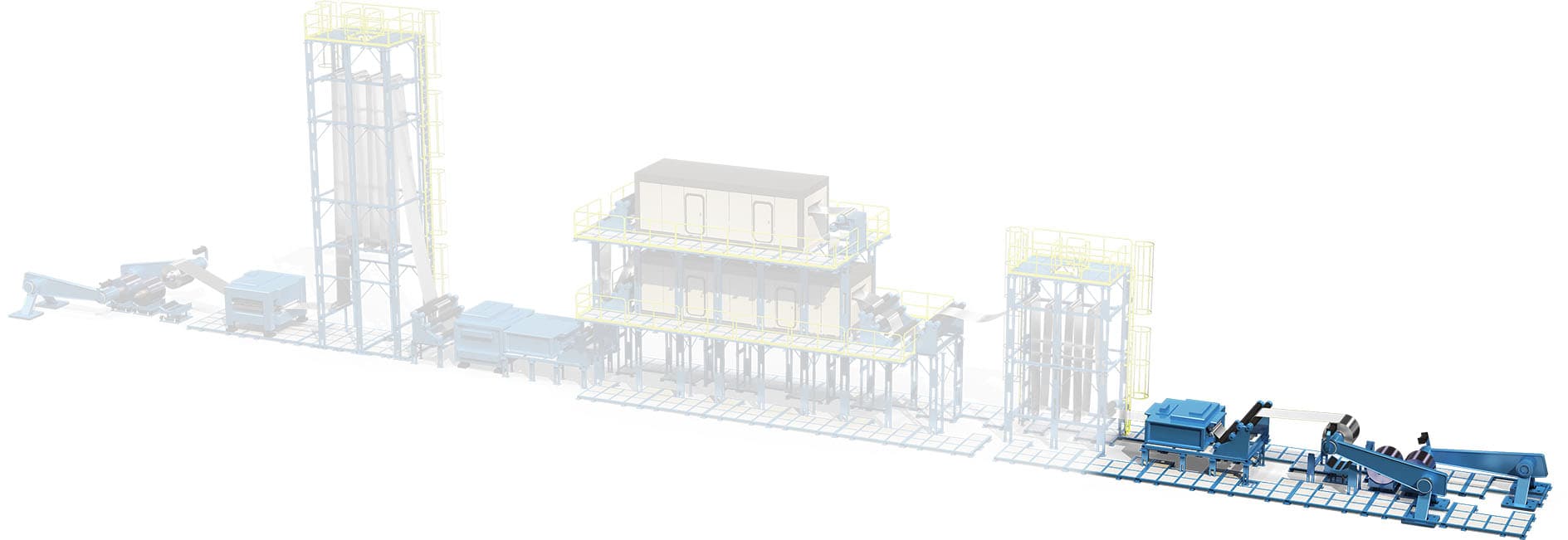
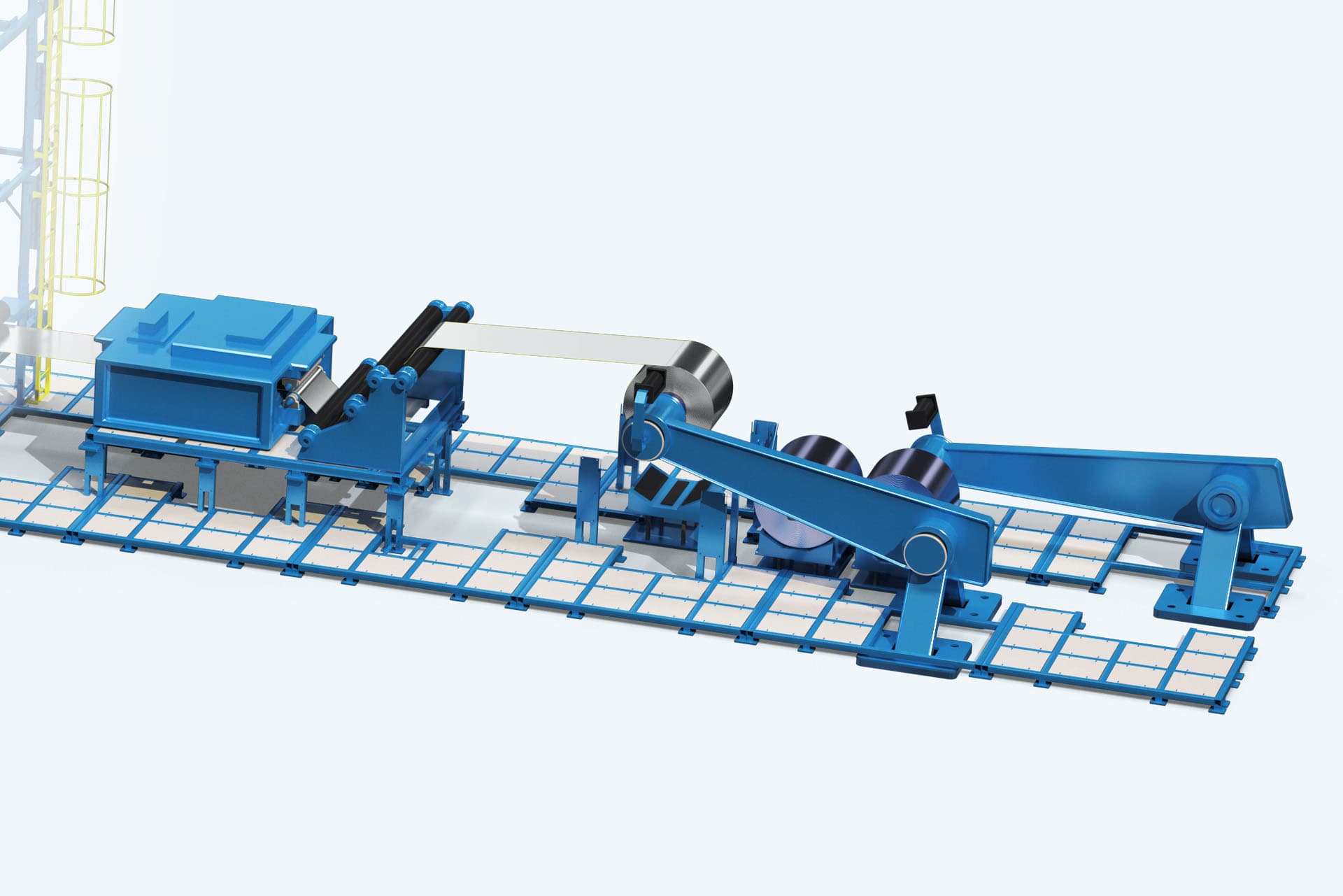
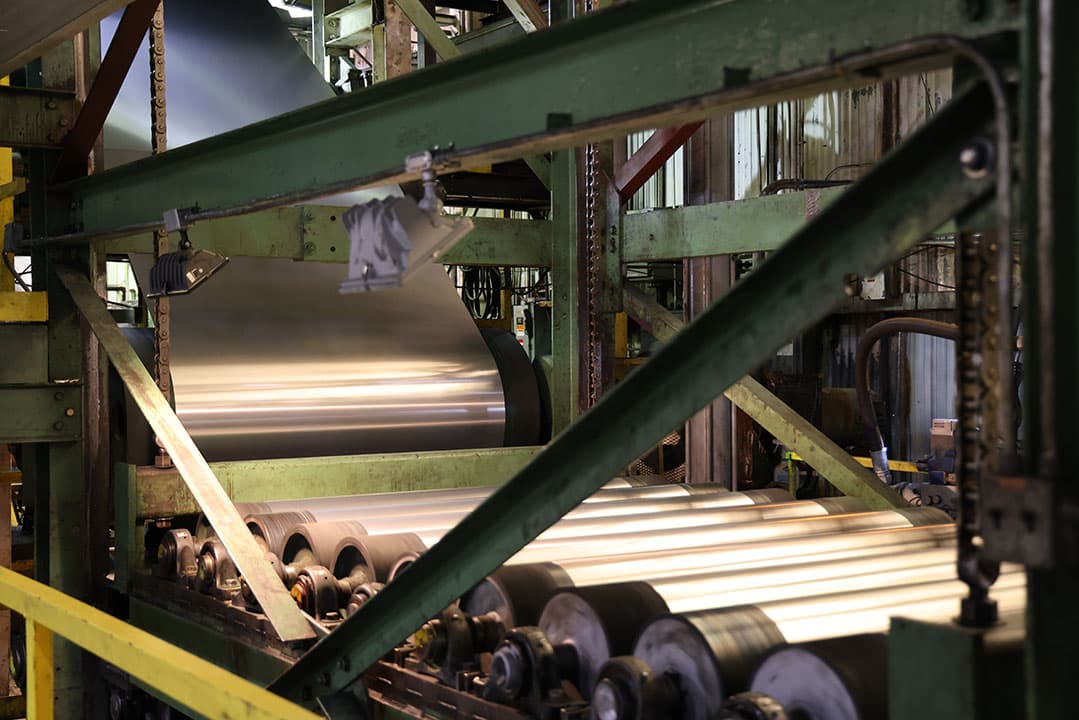
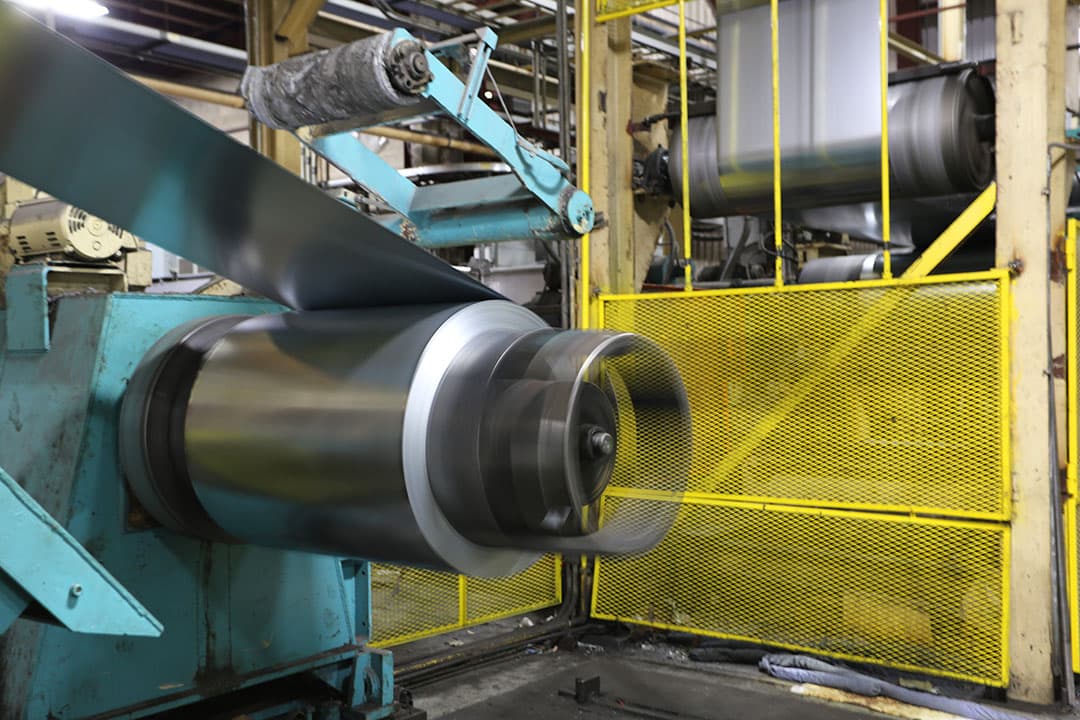
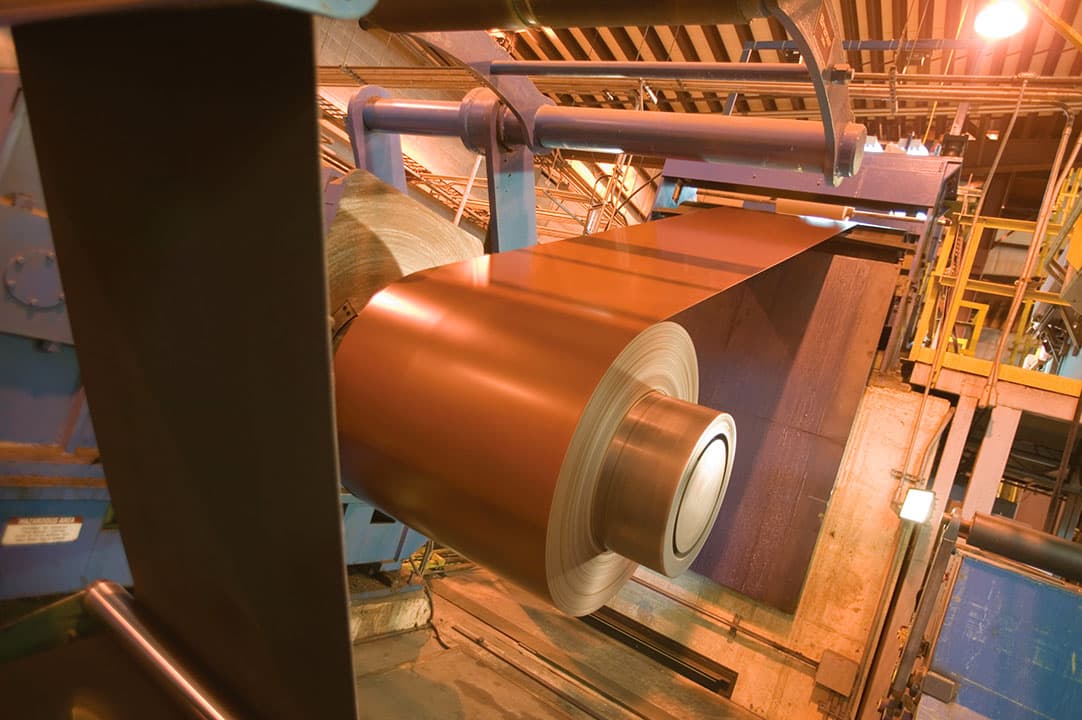
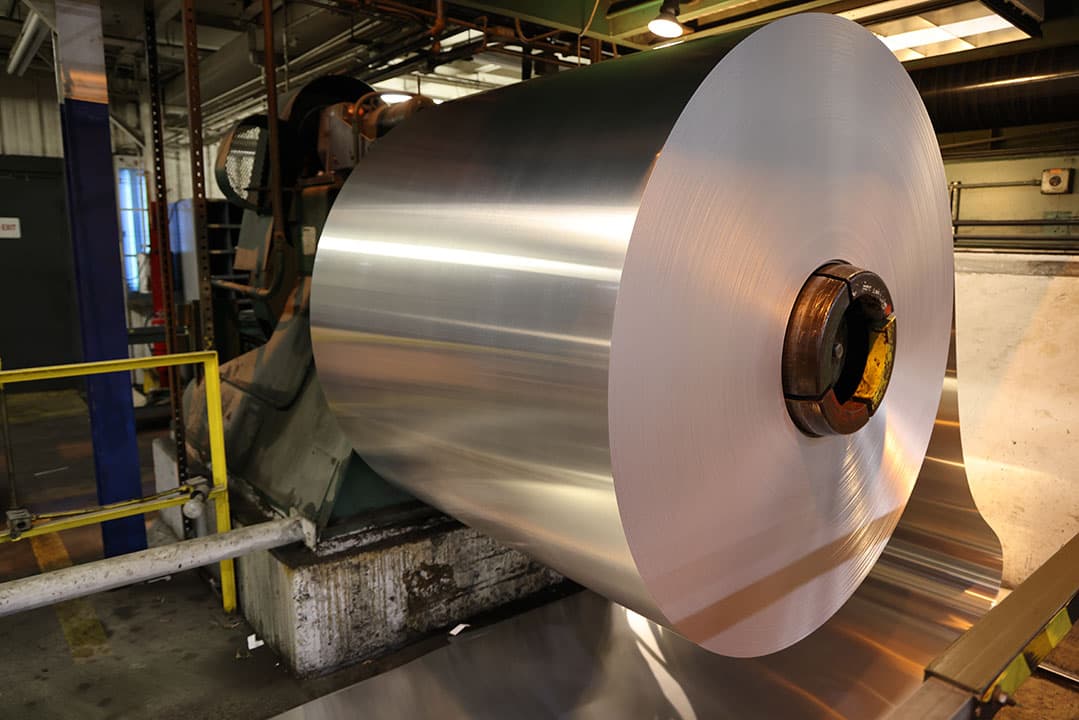
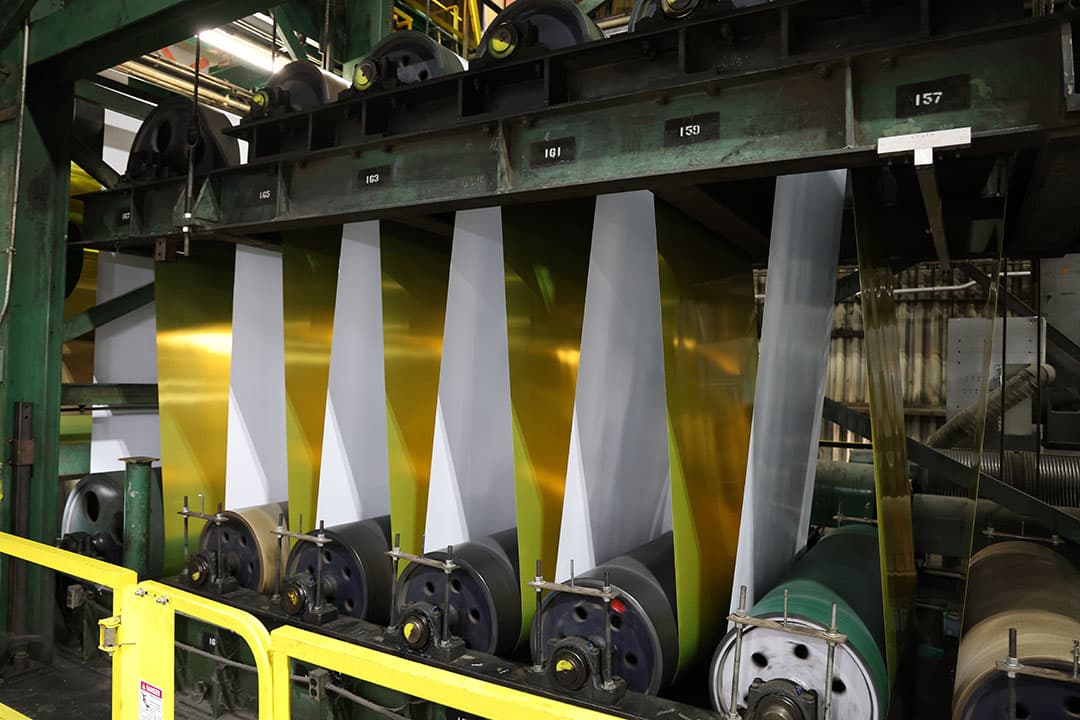
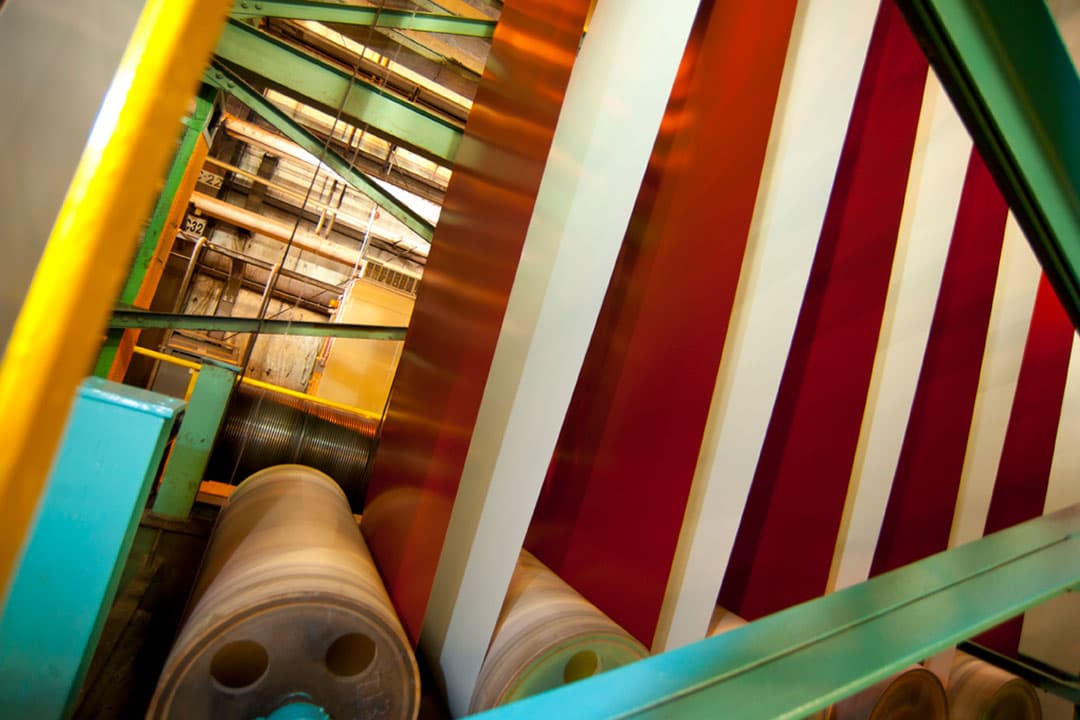
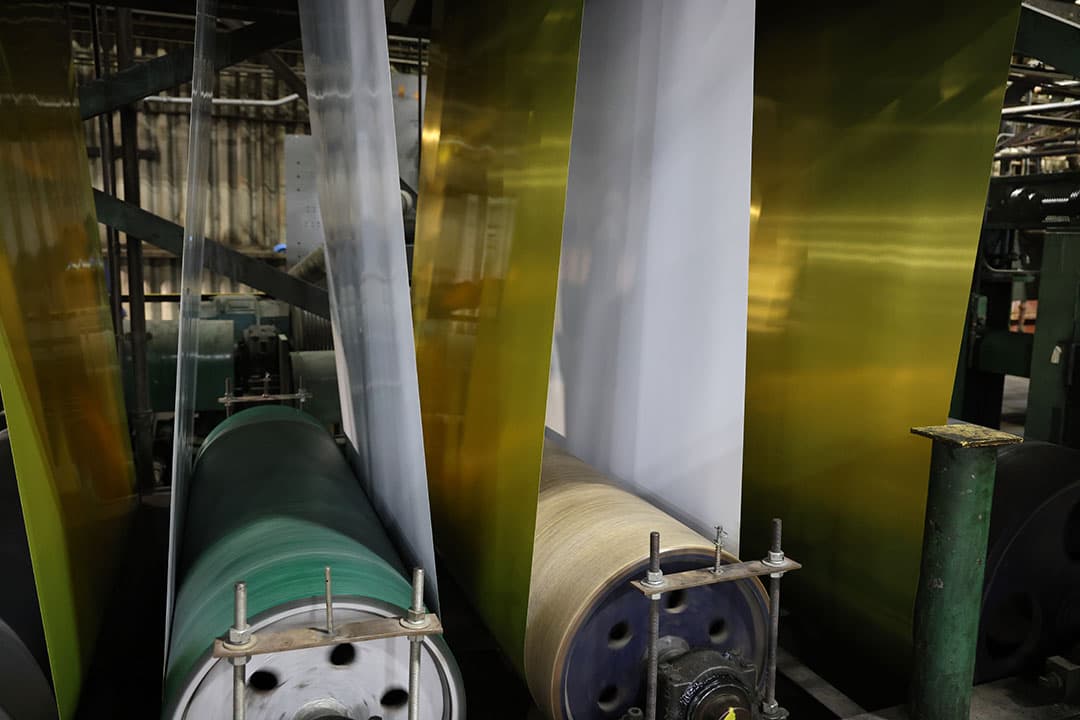
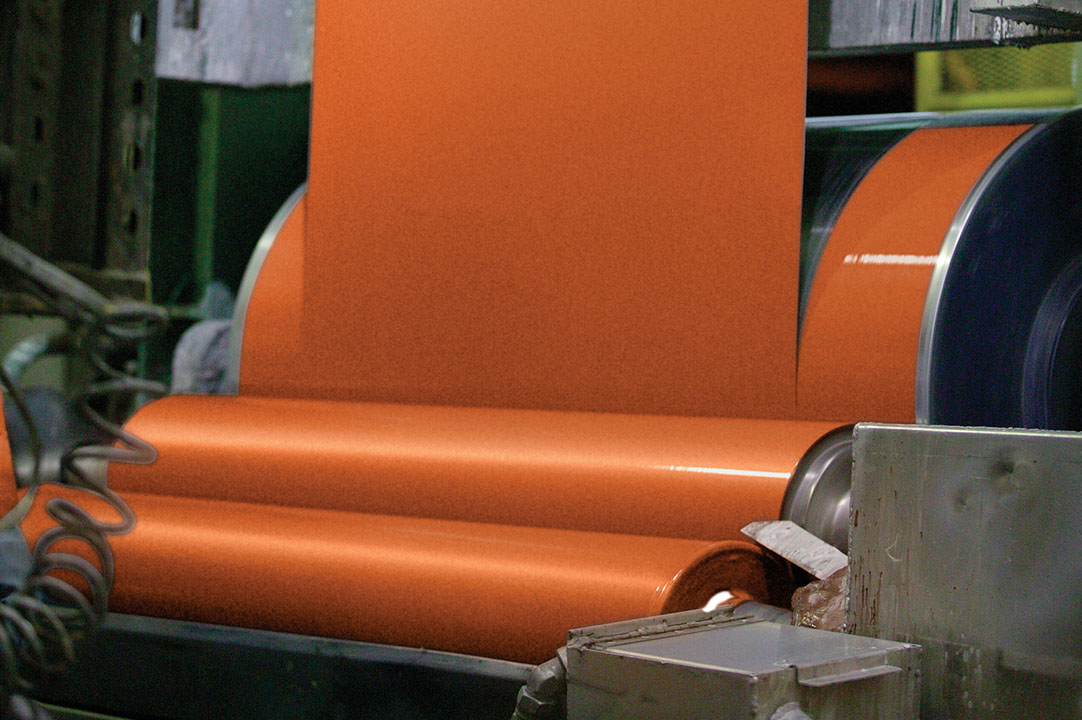
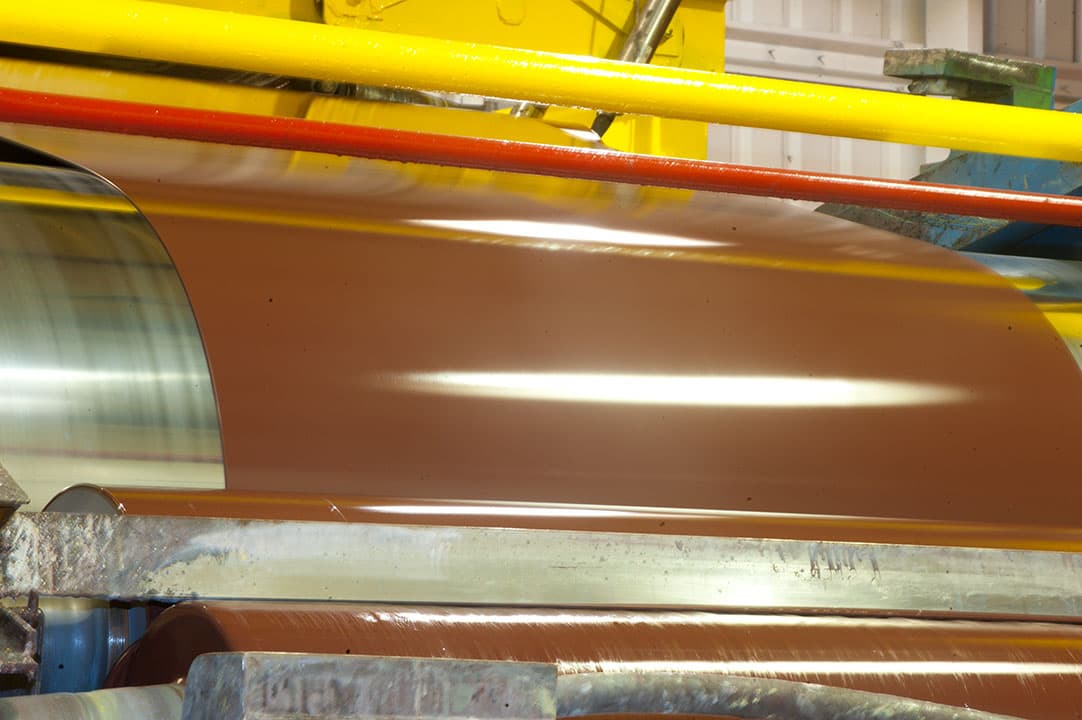
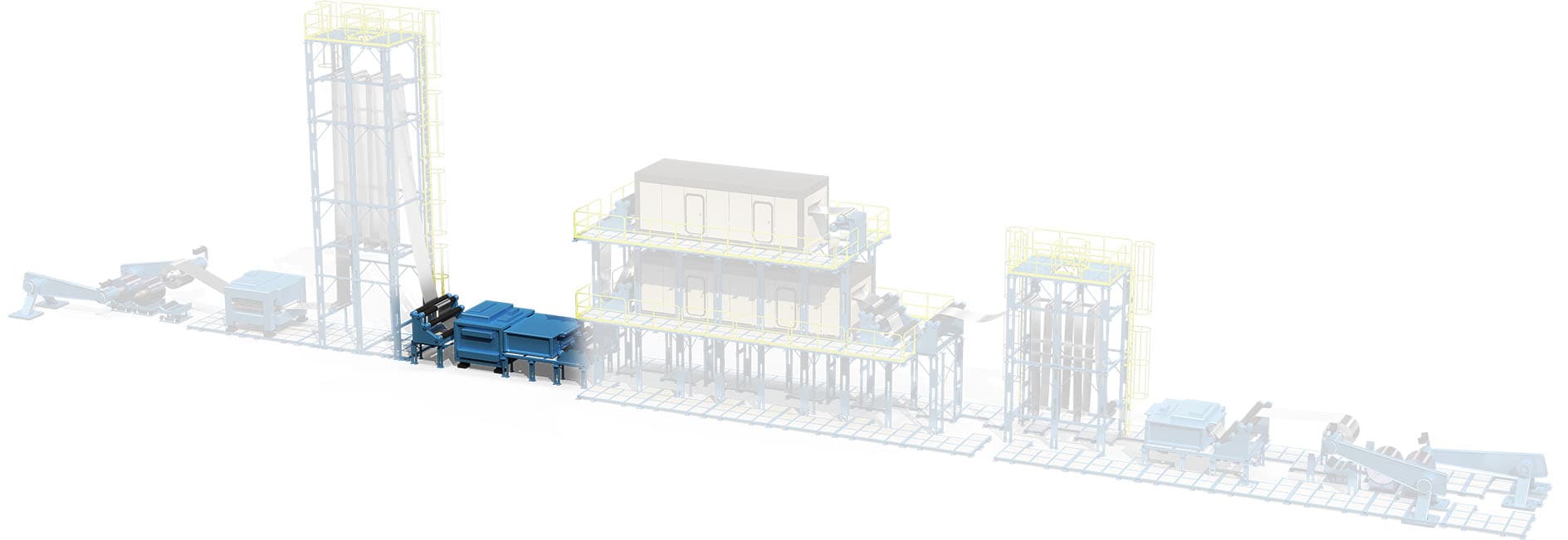
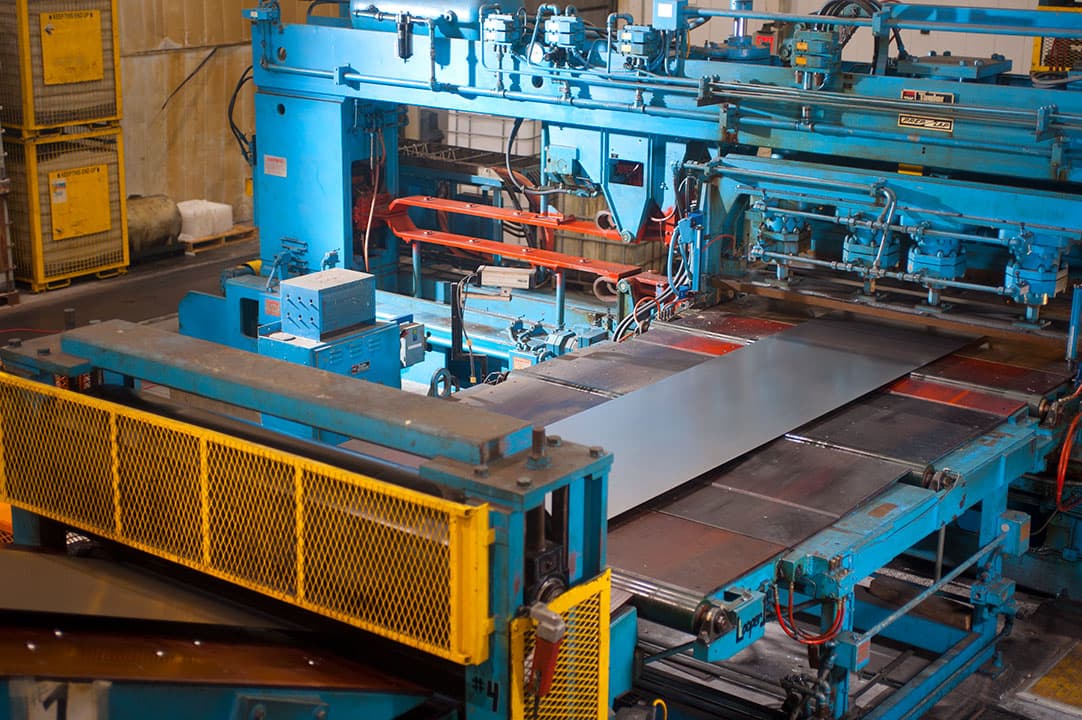
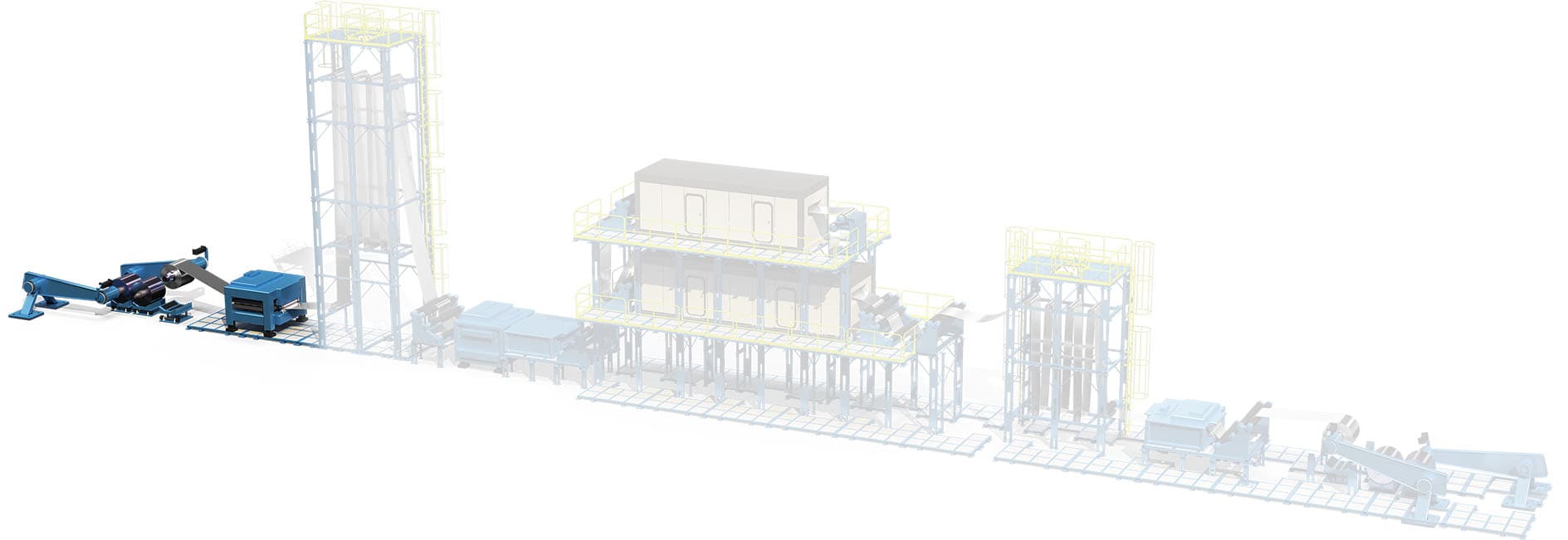
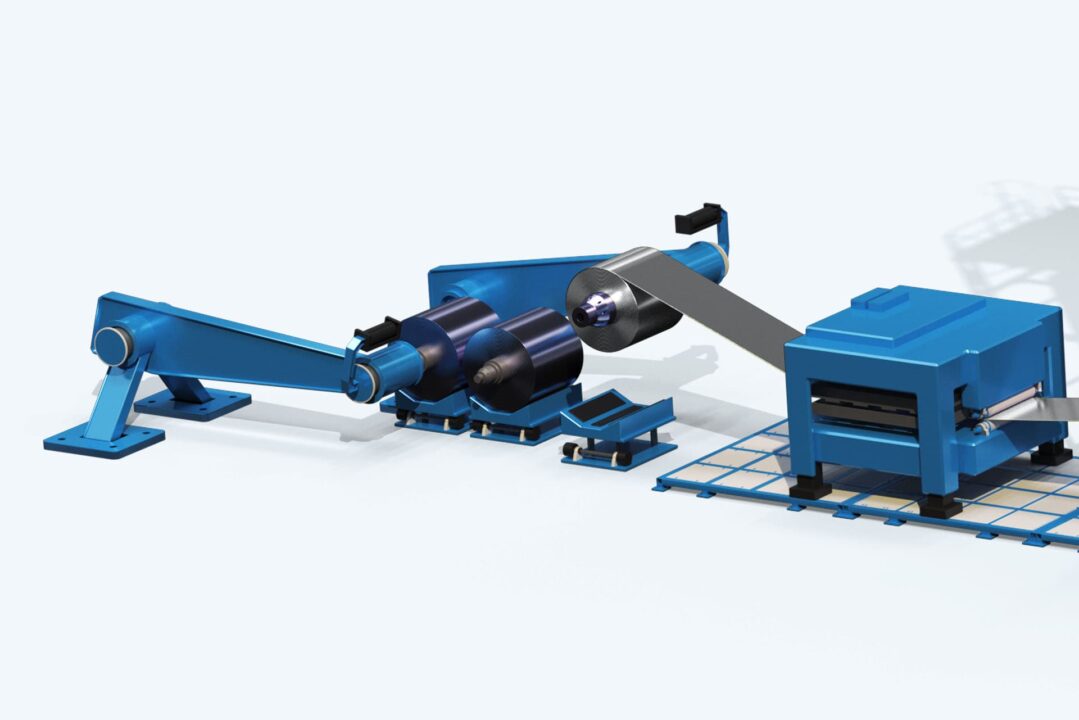
Once the metal is cleaned, treated, and painted, the strip is rewound into a coil size prescribed by the customer. From there, the coil is removed from the line and packaged for shipment or additional processing.
After the primer is applied and cured, then the metal strip enters the finish coat station where a topcoat is applied. Topcoats provide color, corrosion resistance, durability, flexibility and any other required physical properties. Like primers, the topcoat is cured using thermal cure ovens.
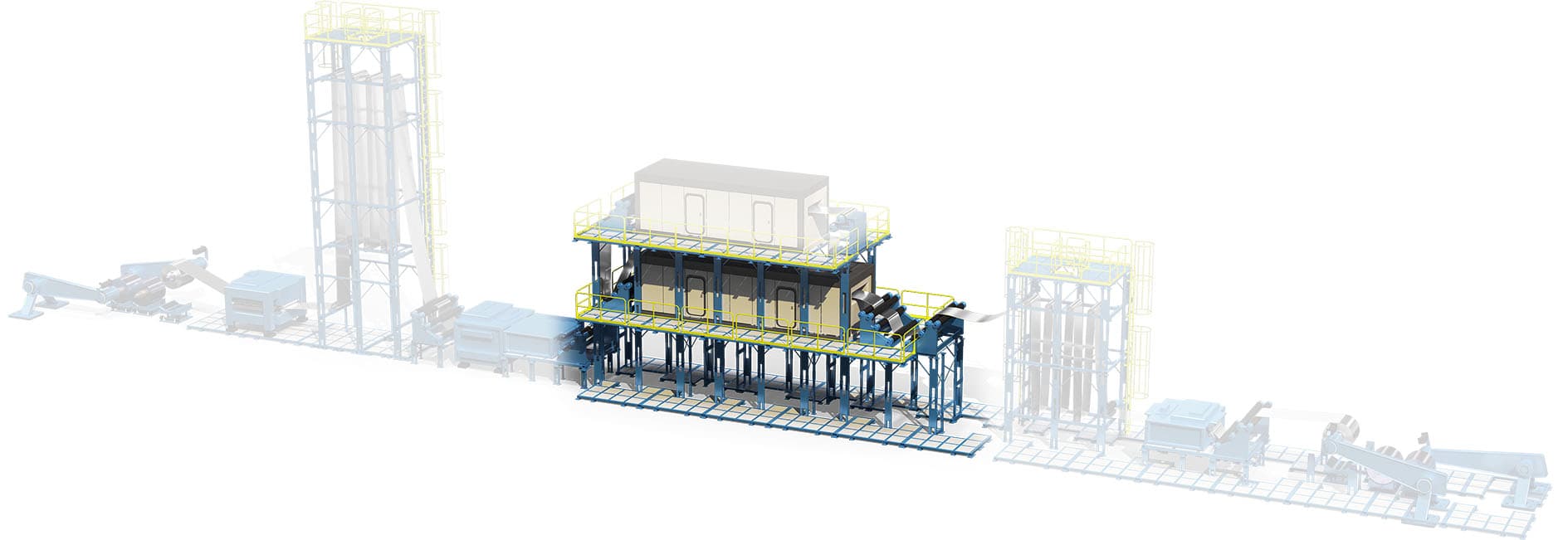
Oven
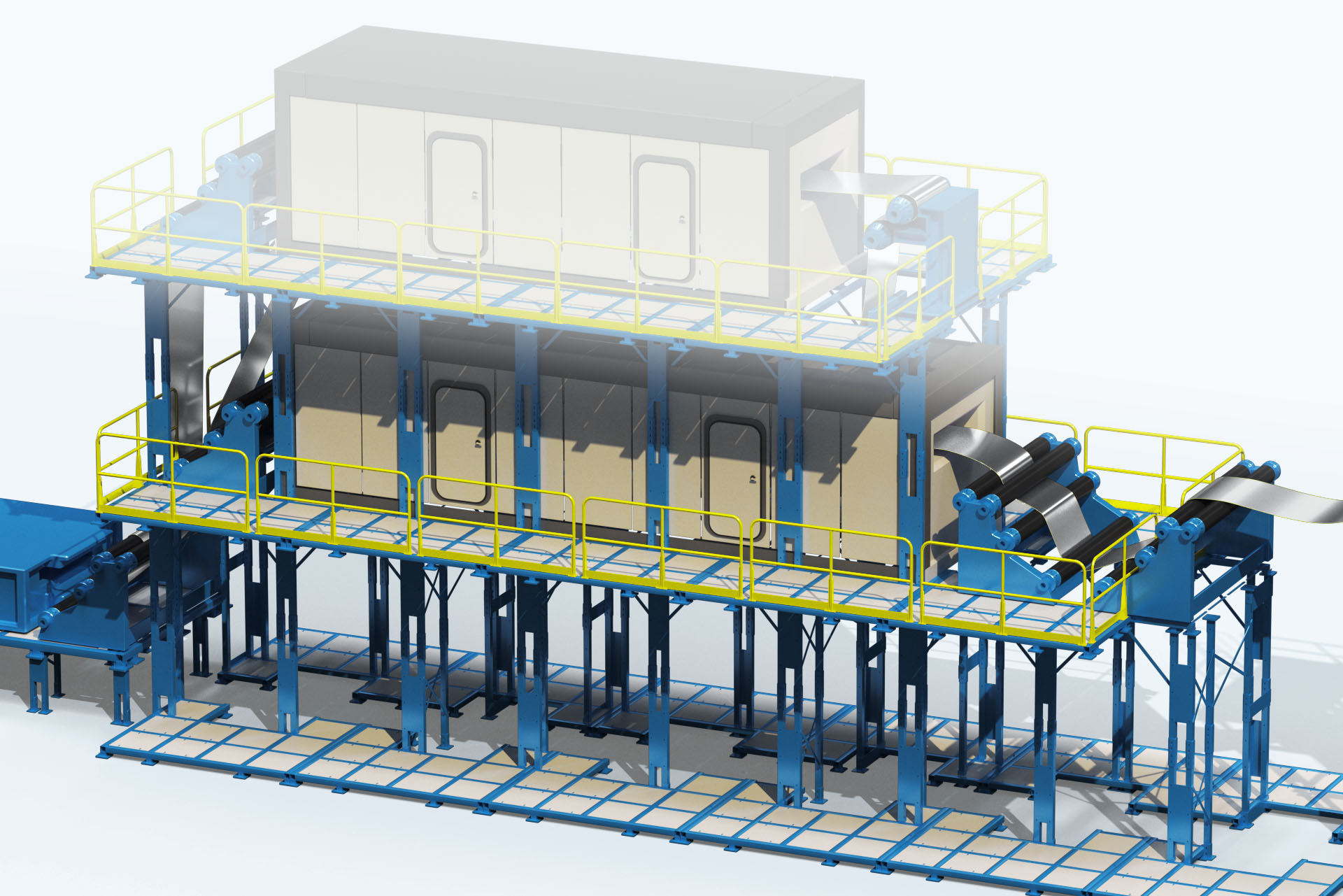
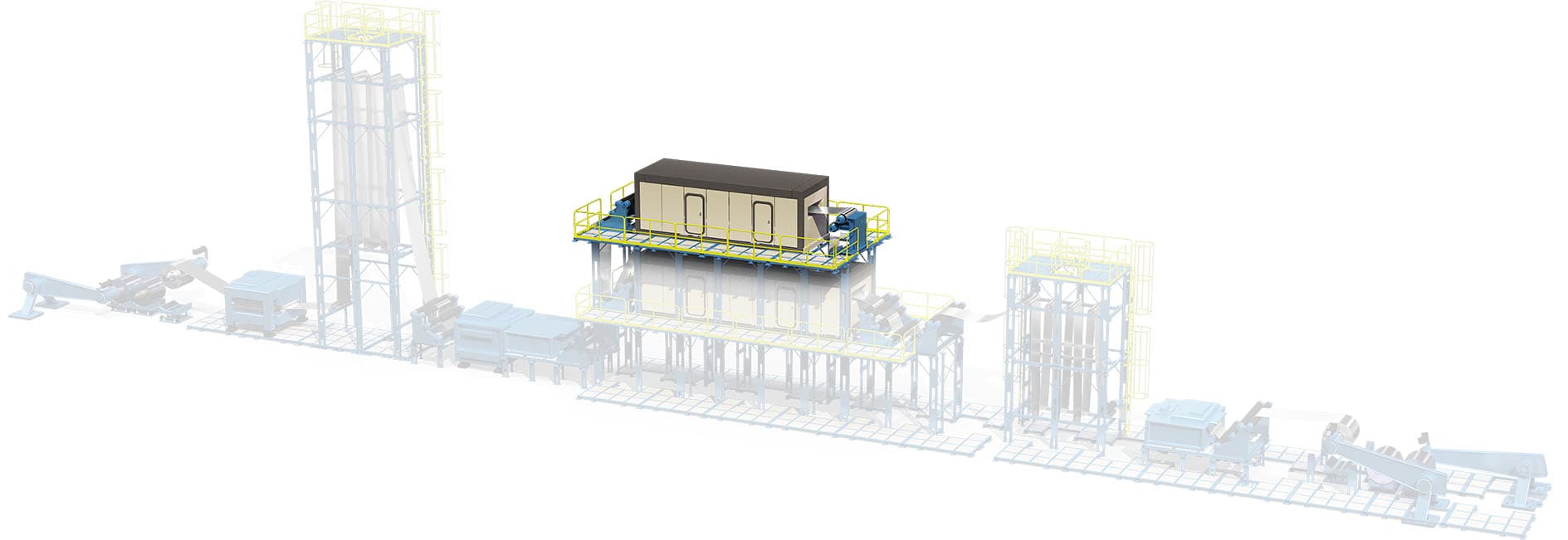
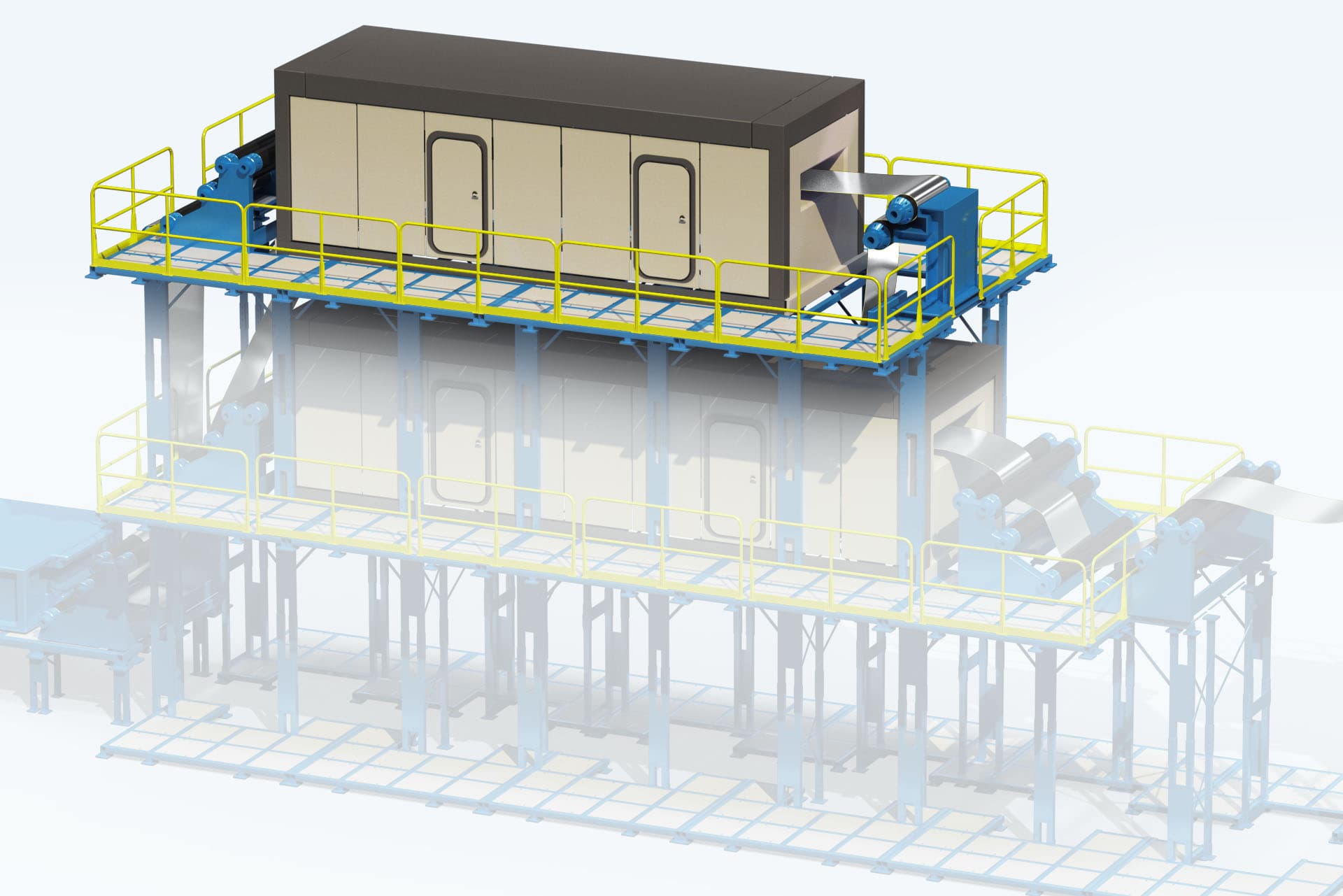
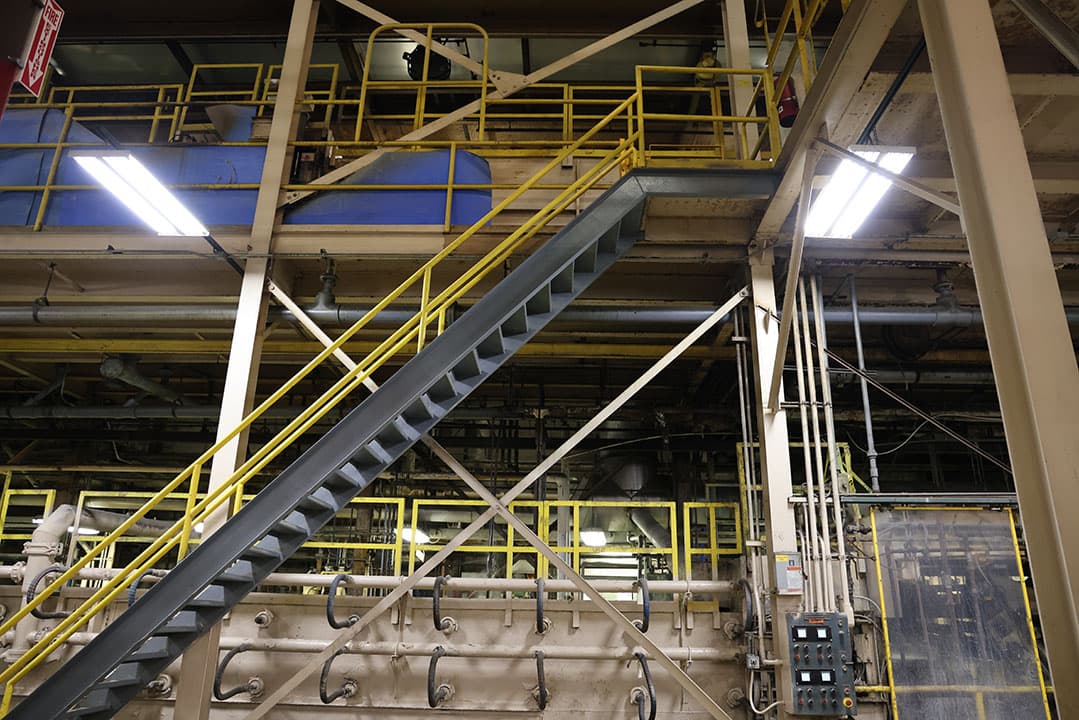
Coil coating ovens can range from 130 feet to 160 feet and will cure the coatings in 13 to 20 seconds.
During this stage, the strip enters the prime coat station whereby a primer is applied to the clean and treated metal. After the primer is applied, the metal strip travels through a thermal oven for curing. Primers are used to aid in paint adhesion, improve corrosion performance and enhance aesthetic and functional attributes of the topcoat.
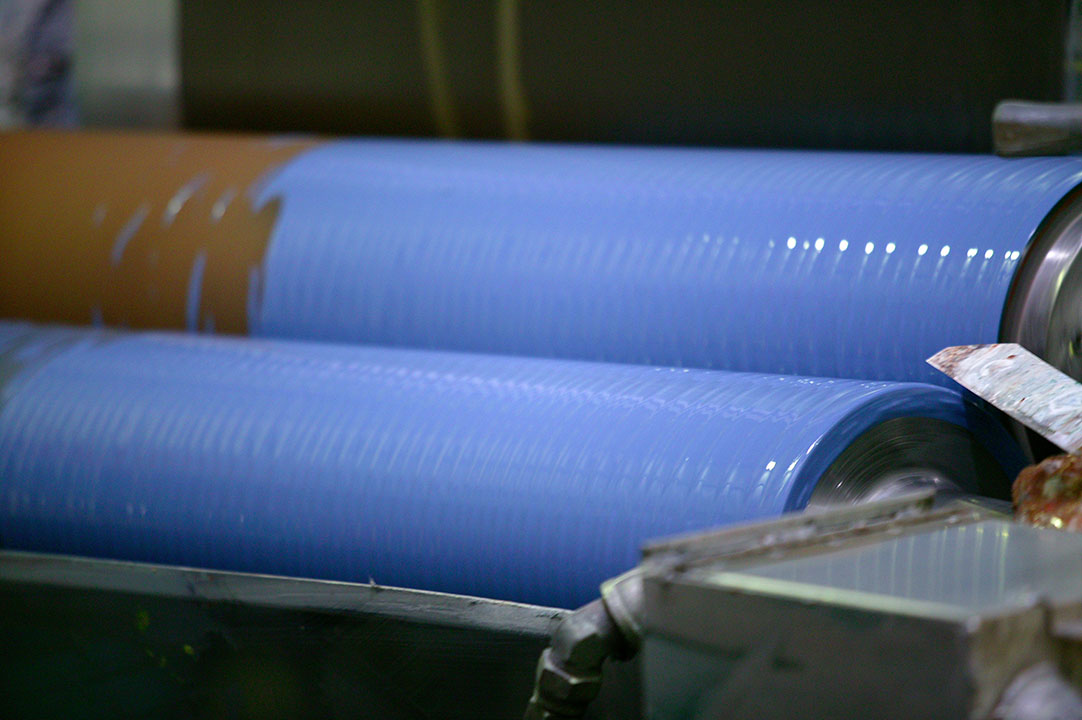
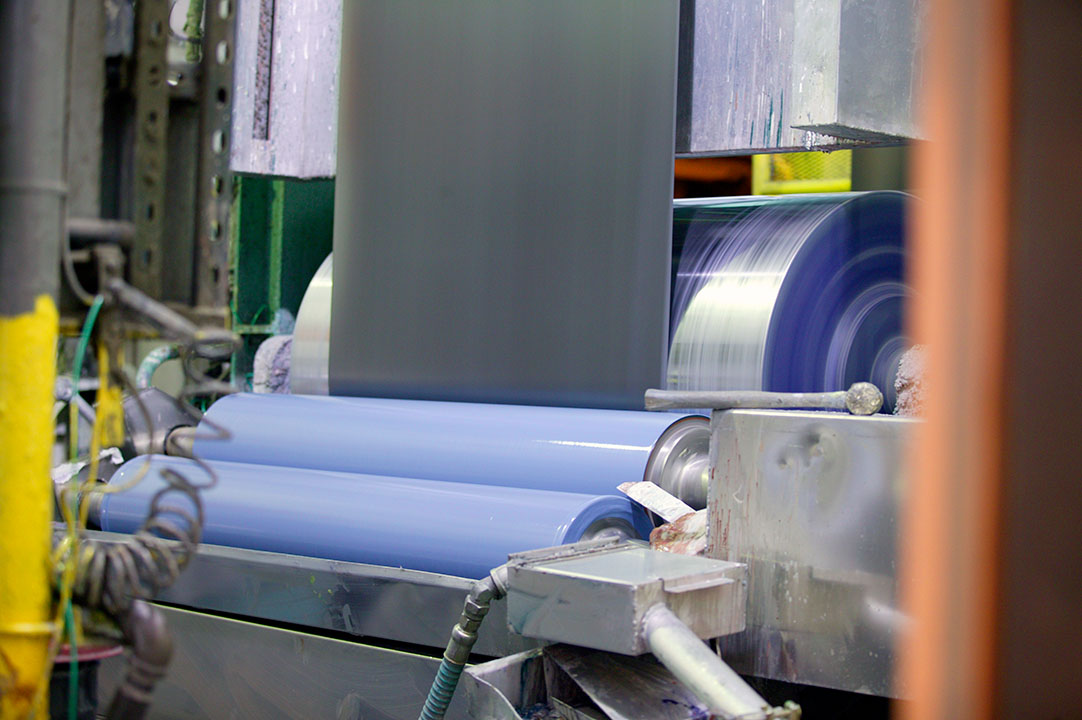
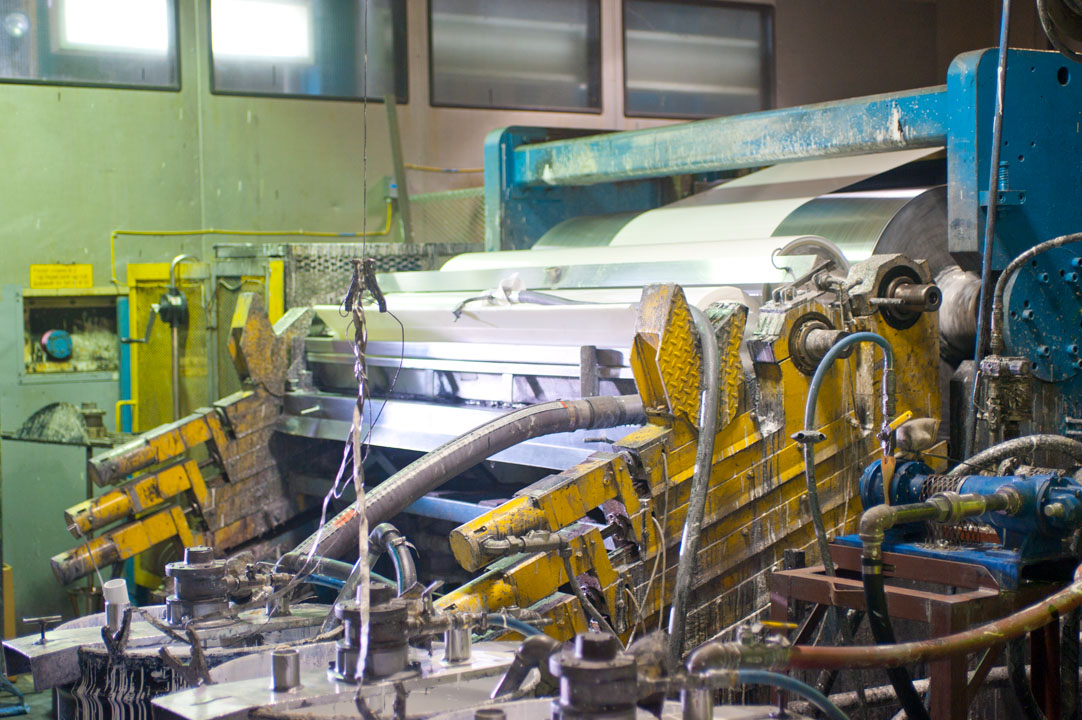
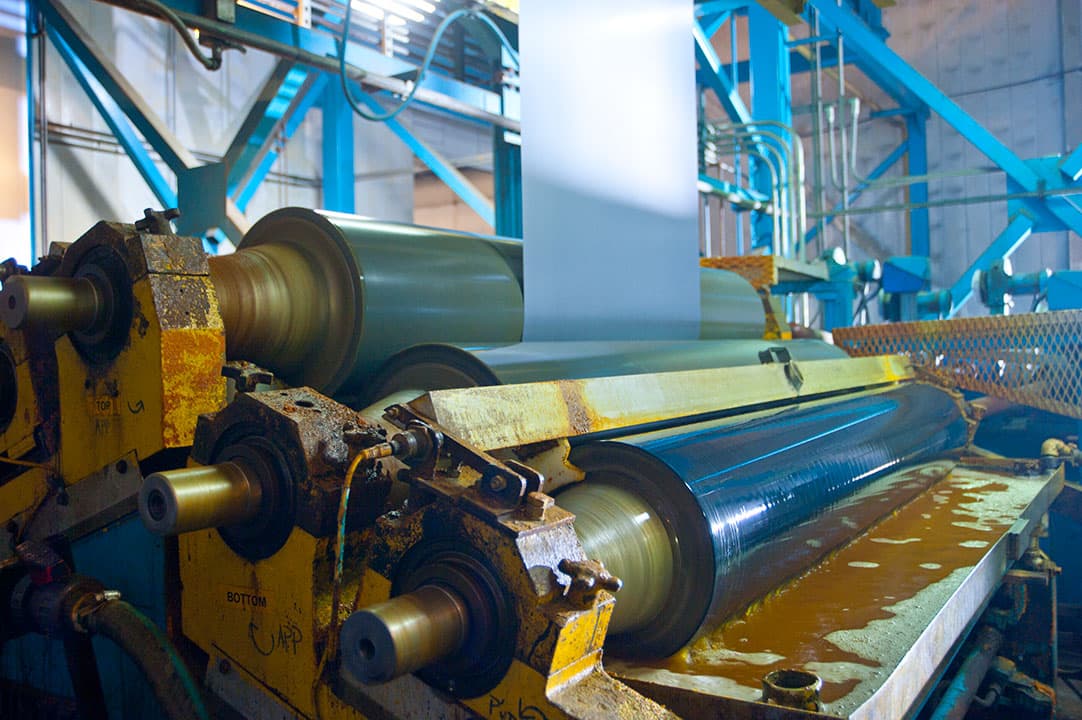
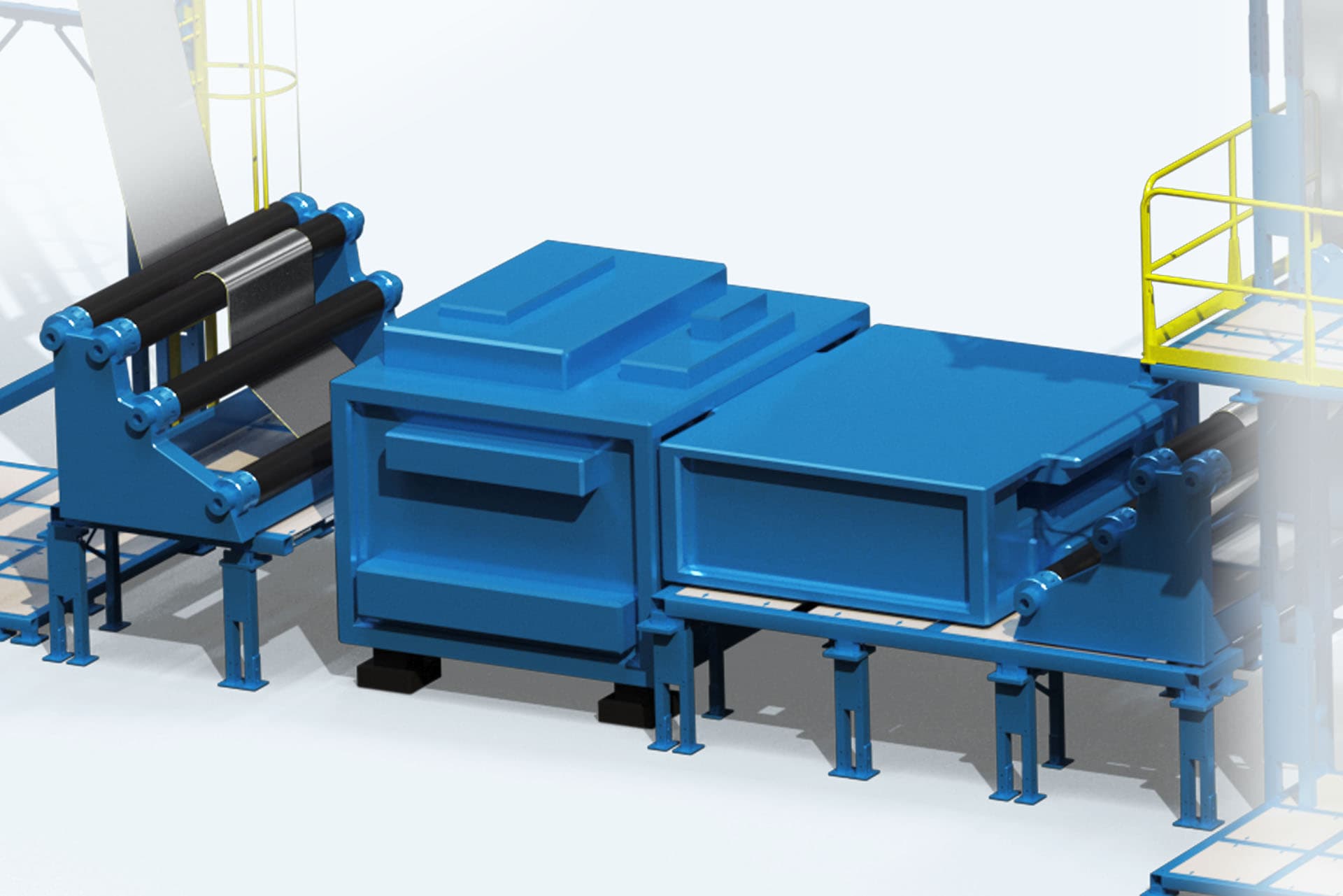
S Wrap Coater
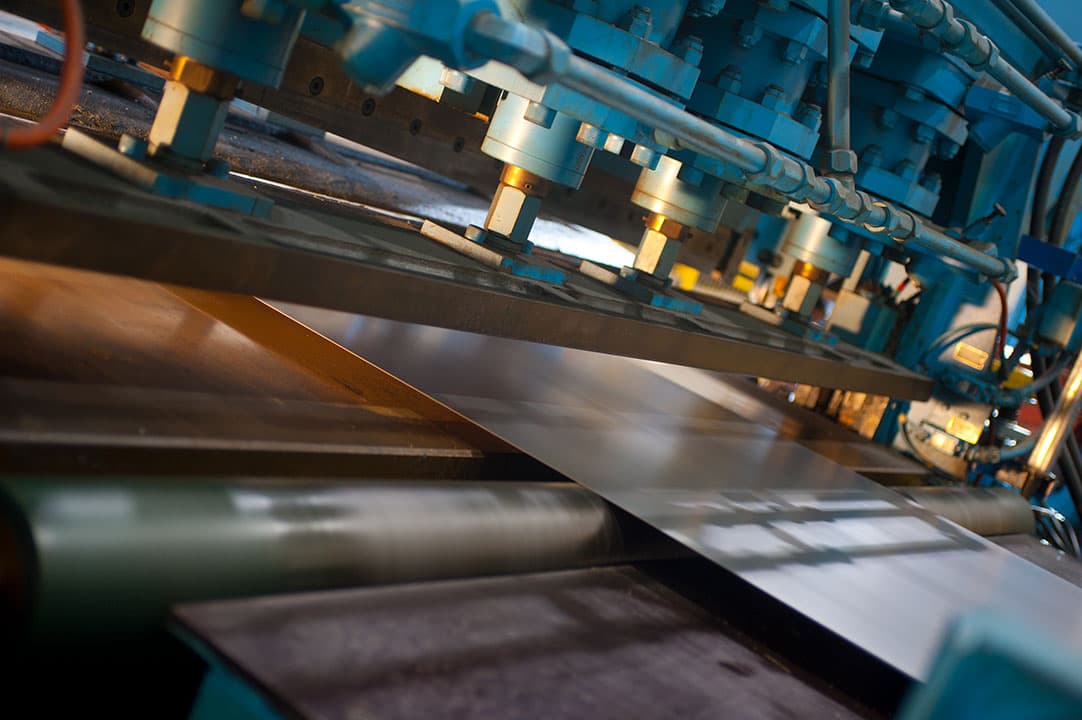
The S wrap coater design allows for primers and paints to be applied to the top and back side of the metal strip simultaneously in one continuous pass.
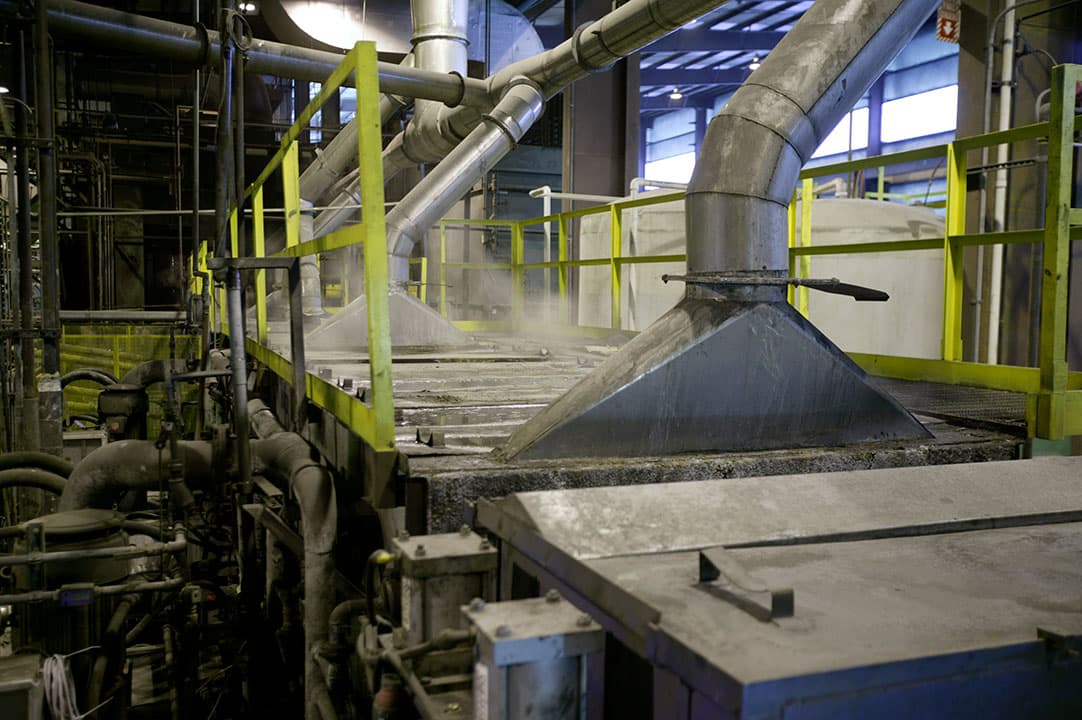
The cleaning and pretreating section of the coil coating process focuses on preparing the metal for painting. During the cleaning stage, dirt, debris, and oils are removed from the metal strip. From there, the metal enters the pretreatment section and/or a chemical coater whereby chemicals are applied to facilitate paint adhesion and enhance corrosion resistance.
Dried-In-Place
In this stage a chemical that provides enhanced corrosion performance is applied. This treatment can be chrome free if required.
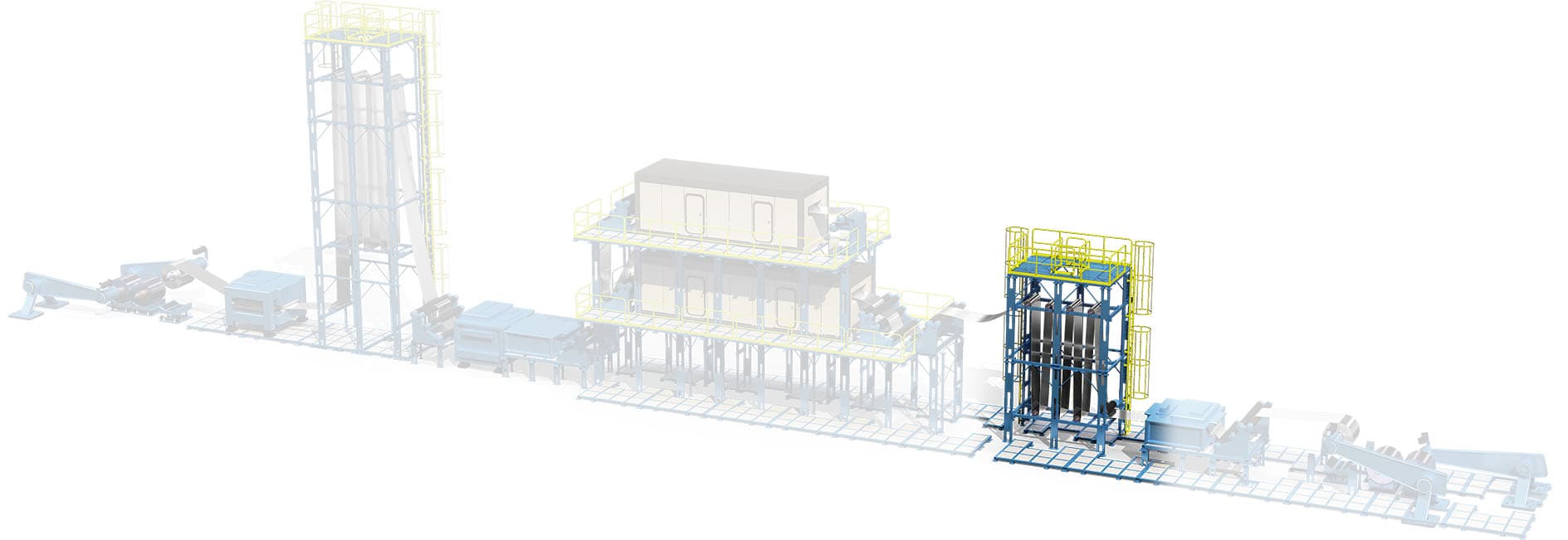
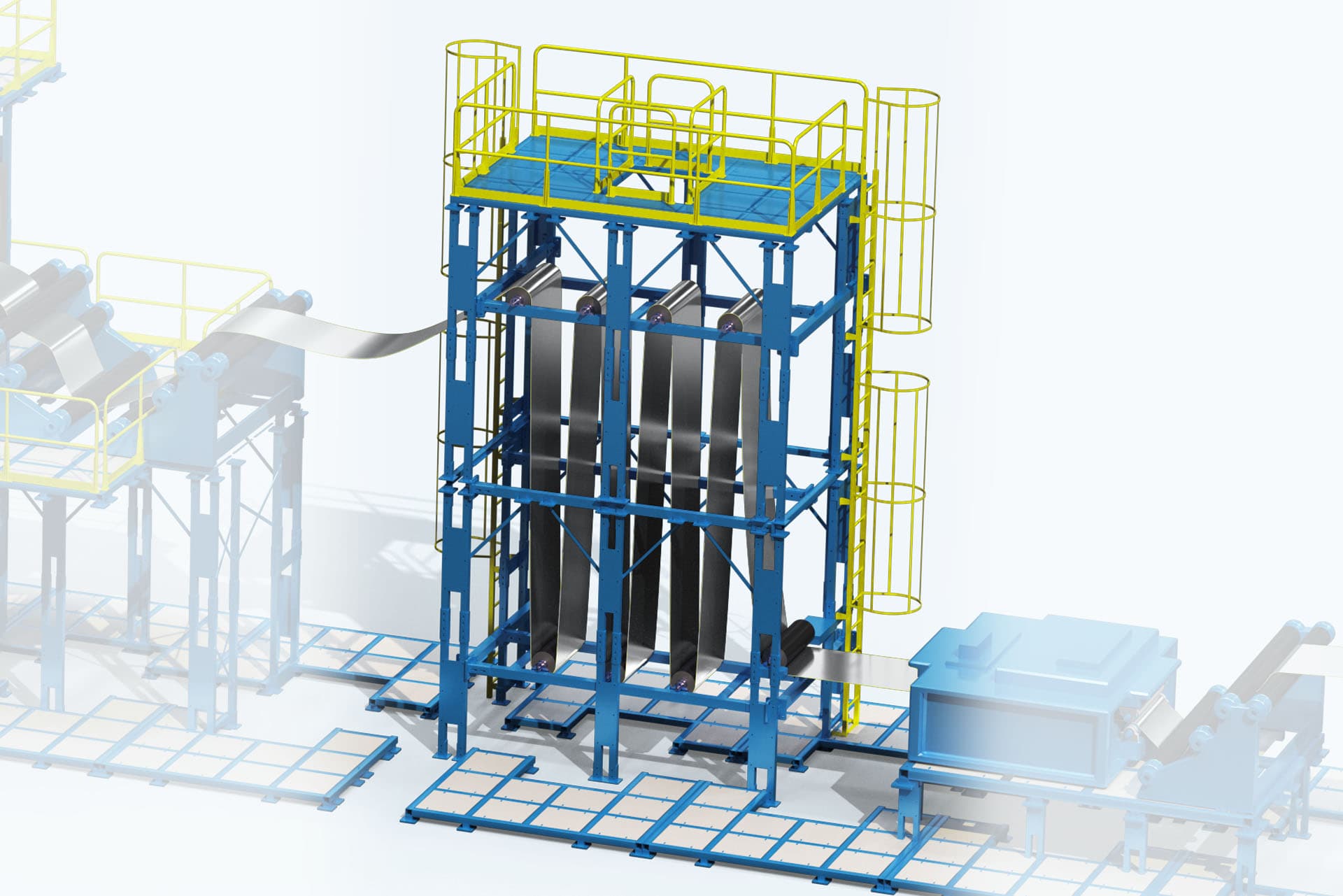
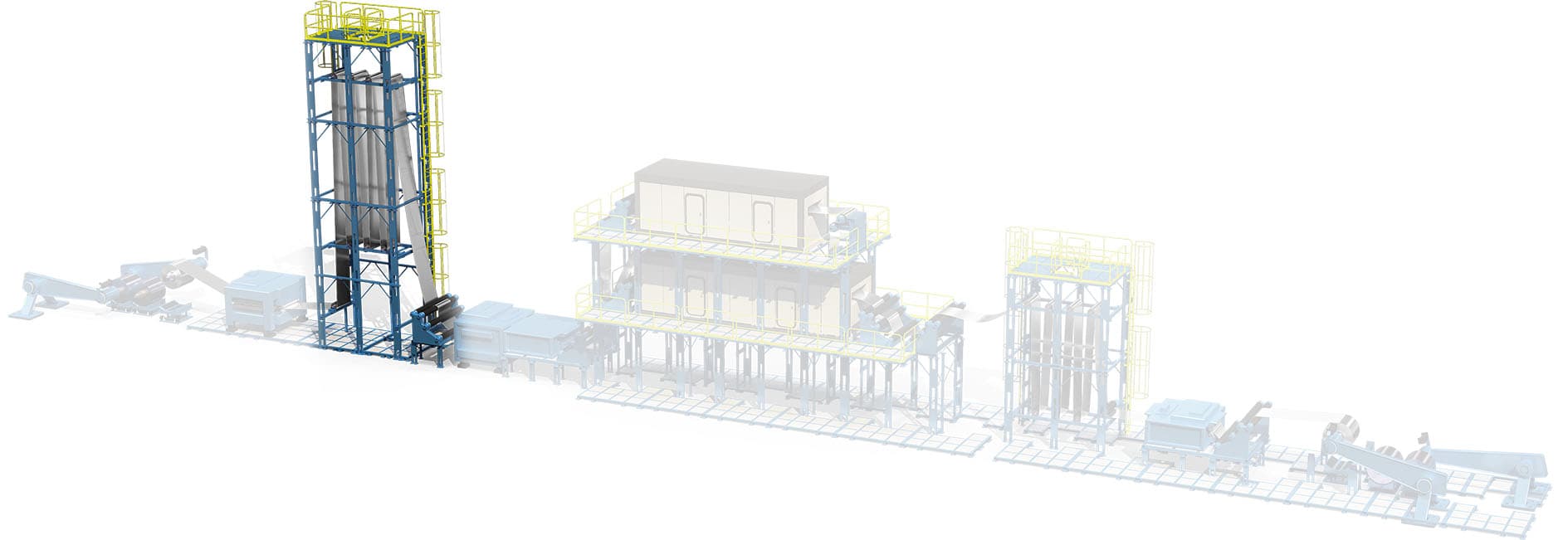
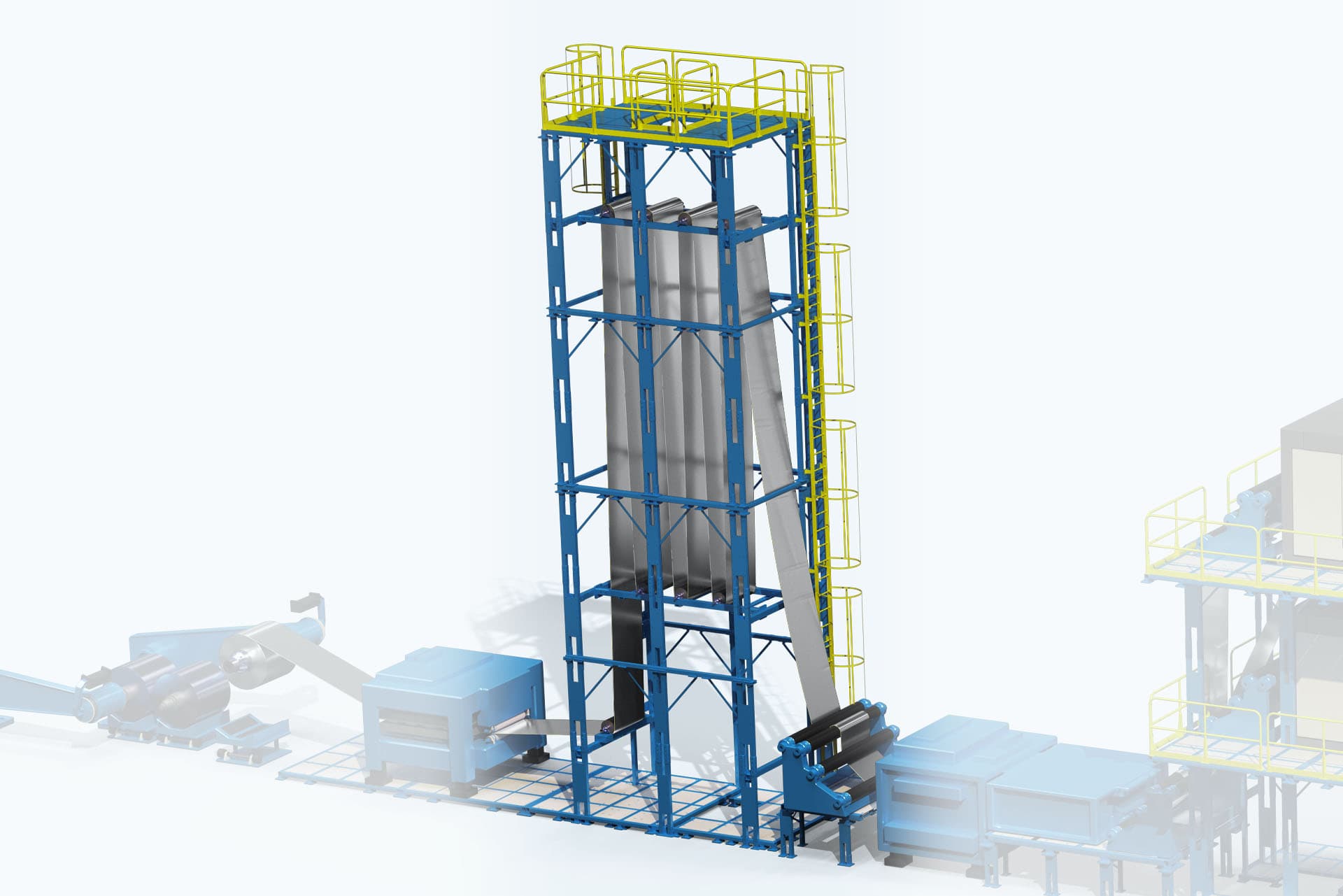
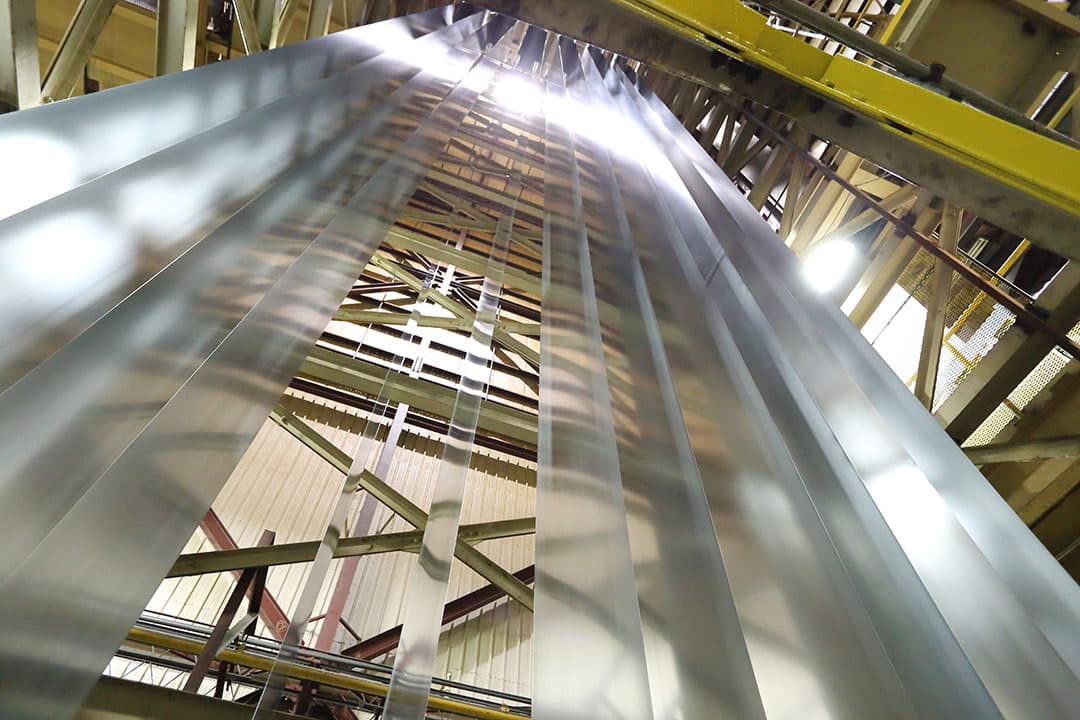
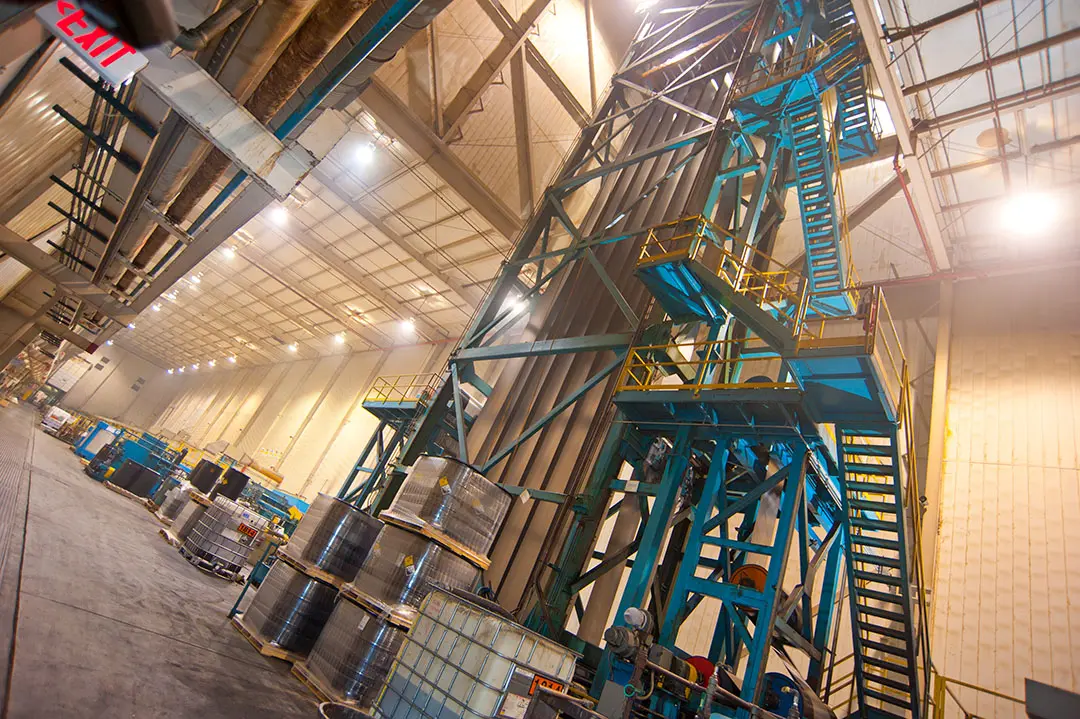
The accumulator is a structure that adjusts up and down to store material, which makes continuous operation of the coil coating process possible. This accumulation will continue to feed the coil coating processes while the entry end has stopped for the stitching process. As much as 750 feet of metal can be collected.
You’ve done your research. You’ve evaluated the price, finished product, overall look and more of both liquid-paint and powder-coat options, and you’d likely consider your dive into the topic done and dusted. After all, you’ve found the best solution for your bottom line. However, have you considered the environmental impact of both options? Do you know which is better for the planet and which might align more directly with your ethics as a business? Let’s take a look.
Liquid Paint vs. Power Coating: The Tale of the Tape
While powder coating is more durable than liquid paint, the benefits of utilizing the process extend far beyond that. Powder coating is safer on several levels, both personal and environmental. In fact, the Environmental Protection Agency (EPA) recommends powder coating as a sustainable coating option. Wet paint storage, especially when handled improperly, can lead to dangerous fires that are harmful for both workers and the environment. Wet paint is also unhealthy for those who work with it on a daily basis. However, the environmental implications of wet paint should also be considered. As it evaporates, liquid paint lets off volatile organic compounds, known as VOCs. VOCs not only lead to personal health issues like respiratory illness but are a tremendous source of industrial-based pollution and ozone damage. Chrome-based primers necessary when painting aluminum is also eliminated with the use of powder coating, which often requires no primer at all. In contrast, the powder-coating process doesn’t contain any liquids, thus avoiding any evaporation-related headaches. Waste associated with powder coating is also not directly hazardous to the environment, leading to easier disposal. There’s less overall waste, as well – overspray associated with powder coating can be reused and recycled, providing up to a 97% utilization rate from a box of powder. Liquid paint can’t be reclaimed in the same way. Powder coating is also safer for those completing the application as long as appropriate precautions are taken to ensure the powder isn’t inhaled or coming into direct contact with skin.
The Choice is Clear
While powder coating should likely already be your coating method of choice due to the benefits it provides in saving costs and lasting longer, its lower environmental impact is yet another way that the process is a step ahead of liquid-paint-based processes. At AZZ, we have an expansive network of powder-coating facilities with state-of-the-art, highly automated operations that enable quick turnaround and further promote environmental and personal benefits. Our powder-coating process is also ISO 9001 certified, and we’ve developed an industry-leading reputation for durable, attractive and long-lasting finishes for items ranging from small parts to items up to 60 feet in length. We’re also committed to sustainability that goes beyond the built-in benefits of powder coating. We also utilize 100% naturally occurring zinc in our hot-dip galvanizing process, part of a wholly recyclable process that involves no VOCs.
If you’re ready to up your commitment to environmentally sustainable coating options, contact us today at azz.com/request-more-information.
Durable protection for parts measuring less than an inch to components up to 60 feet in length
Comprehensive coverage for complex and detailed designs
An array of color and texture options for aesthetics and compliance with safety codes
Protection strong enough for the defense industry
AZZ is a leading provider of chemical agent resistant coatings (CARC) meeting military specifications and providing the highest level of protection against radioactive, chemical, and biological warfare agents for large format and heavy equipment parts.
Sandblasting surface prep
With extensive expertise in sandblasting, AZZ provides the surface preparation critical for a high-quality, consistent finish for parts ranging in size up to 40 feet in length.
Large-scale production and fast turnaround capabilities
AZZ’s North American network of state-of-the-art, highly automated facilities enables us to integrate seamlessly into your supply chain and provides the capacity and fast turn-around times to meet your most demanding production schedules with consistent, on-time delivery.
Using the AGA Life-Cycle Cost Calculator, a quantitative analysis was conducted comparing hot-dip galvanizing to four paint systems, as well as a duplex system and metallizing with defined maintenance schedules.
Initial Cost:
Including materials (paint, metallizing, etc.), the number of coats, the surface prep cleaning method (painted systems: SP-10; duplex: SP-16/ASTM D6386; metallizing: standard near white metal), where the application was performed, and labor costs versus galvanizing’s all-inclusive price:
Coating System
$/ft2
Total
Hot-Dip Galvanizing
$1.76
$ 88,000
Epoxy/Epoxy
$2.92
$ 146,150
Epoxy/Polyurethane
$3.35
$ 167,650
Inorganic Zinc/Epoxy
$3.17
$ 158,650
Inorganic Zinc/Epoxy/Polyurethane
$4.53
$ 226,300
Galvanizing/Epoxy/Polyurethane (Duplex)
$5.28
$ 263,950
Metallizing
$8.37
$ 418,550
These findings indicate that when all the costs are considered, galvanizing is often less expensive and at the very least, exceedingly competitive with other coating systems.
Life Cycle Cost:
Utilizing a practical maintenance cycle over the prescribed 75-year lifetime of the project based on Net Future Value (NFV) and Net Present Value (NPV) calculations at 3% inflation and 2% interest, and accounting for a very unlikely needed maintenance paint with an inorganic zinc at year 70 for the galvanized steel:
Coating System
$/ft2
Total
Hot-Dip Galvanizing
$ 4.29
$ 214,500
Galvanizing/Epoxy/Polyurethane (Duplex)
$22.84
$1,142,000
Inorganic Zinc/Epoxy
$39.92
$1,996,000
Inorganic Zinc/Epoxy/Polyurethane
$41.53
$2,076,500
Epoxy/Epoxy
$51.91
$2,595,500
Epoxy/Polyurethane
$61.63
$3,031,500
Metallizing
$62.80
$3,140,000
Even with the one maintenance cycle near the end of the life of the project, hot-dip galvanizing was proven to have a significantly more economical lifecycle than that of the other coating systems.
Galvanized Steel Protects Your Investment
To maximize return on investment, it’s critical that buyers ensure the longevity of their purchase. Enhanced over 200 years, galvanizing is a process that best protects steel for long-lasting, corrosion-free performance. In fact, galvanized components can potentially last up to a century without the need for costly maintenance, delivering a significantly lower lifecycle cost, especially when compared to alternatives like stainless steel, aluminum, and epoxy coating. And research suggests that non-galvanized structures incur indirect costs as much as 11 times higher than those that utilize galvanized products. In an economy where steel prices are expected only to rise, buyers are wise to protect their investment and achieve cost savings by galvanizing.
GalvXtra Hot-Dip Galvanizing
AZZ’s GalvXtra four-step, hot-dip galvanizing process uses a proprietary formulation of molten metals to deliver consistent, high-quality zinc coatings on ferrous materials. At the preparation stage, steel arrives at AZZ’s galvanizing plant and is inspected to ensure that drainage and venting requirements are met. Then, the metal is cleaned by immersion in a hot alkali solution, acid pickled to remove rust or scale, and fluxed to eliminate surface oxides. Next, the steel is hot-dip galvanized—submerged in a bath of molten zinc to form a shield of zinc/iron intermetallic layers on all surfaces. Finally, the newly galvanized steel is cleaned, weighed, and carefully inspected with calibrated instrumentation to ensure quality standards.
Trust Your Steel to AZZ
AZZ performs hot-dip galvanizing for steel components used in a wide range of applications, including agriculture, bridge & highway, construction, electrical utility, industrial, original equipment manufacturers, petrochemical, recreational, and transportation. Backed by 60 years of experience in the materials industry, AZZ offers exceptional galvanizing service at over 40 locations across the U.S. and Canada. Click to learn more about protecting your steel investment.
Many AZZ employees lost homes, cars, and even simple necessities, such as clothing and mattresses during the worst flooding since Hurricane Harvey. In light of this recent flooding, the AZZ Cares Foundation is seeking donations for the employees who are in urgent need of assistance.
As an example of just one of the 19 plant workers who is requesting assistance, Ricky Harper, a production worker for AZZ Galvanizing – Beaumont, lost his car in the floodwaters while trying to take his wife, Stacey, to her monthly cancer treatment at MD Anderson in Houston. Hours later, the couple had to grapple with another loss – their home, which was in ruins because of the catastrophic flooding.
“Taking care of my wife and being blessed with a job is what keeps me going through hard times like this, said Ricky. “I’m the one who takes care of her, so I have to keep going no matter what.”
Please help all the AZZ employees impacted by the storm, and that have requested assistance, by donating today at: https://www.azzcaresfoundation.org/Beaumont. The AZZ Cares Foundation is supported 100 percent by generous donors like you, and is currently behind in reaching its yearly donation goal. To continue providing assistance to those in need, we urgently need your help. Please go online and donate today. Your donation is tax deductible, and 100% of all donations received go directly to those in need of assistance.
For more information about the Foundation’s mission, past successes, and to join our reoccurring donor program, please visit azzcaresfoundation.org.
Thank you for your continuing support and consideration,