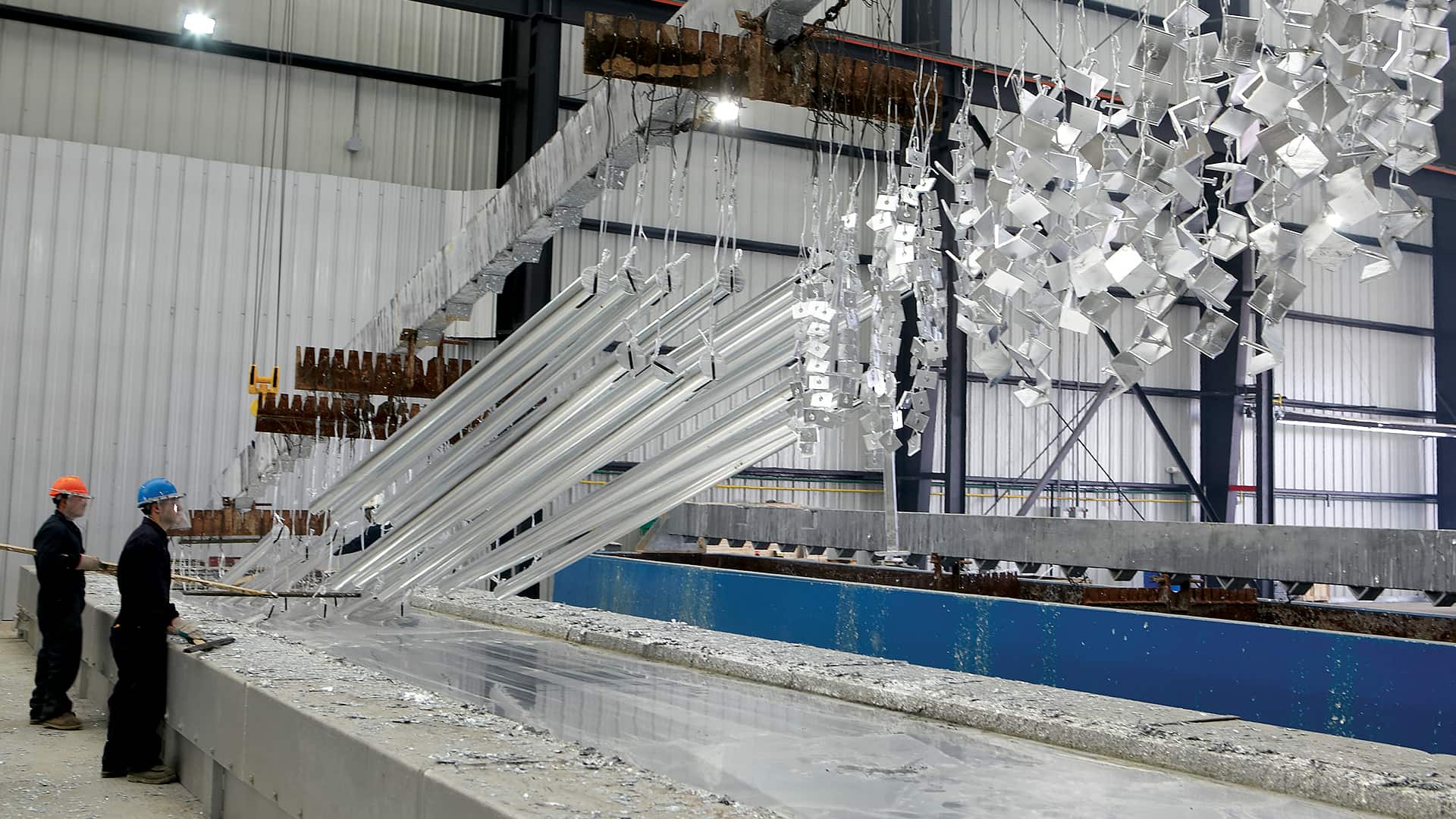
Stripping and re-galvanizing is a well-established process that allows steel to be restored rather than replaced, extending the life of existing assets while maintaining high levels of corrosion protection. The process involves removing the original zinc coating, typically through a controlled acidic solution, and then reprocessing the steel through the standard galvanizing cycle to apply a new protective layer.
This approach is commonly used when a galvanized coating does not meet specification due to thickness variation or surface defects, allowing the material to be corrected without scrapping it. It is also relevant when steel is modified after galvanizing through cutting, welding, or drilling, which exposes bare steel and compromises protection. In these cases, re-galvanizing can restore a uniform coating across the entire component. Over time, even high-quality galvanized coatings will eventually be consumed in aggressive environments, and re-galvanizing offers a way to renew protection and extend service life. It may also be considered when steel is repurposed into a more corrosive environment that demands a higher level of protection.
Before proceeding, several important factors should be evaluated. The base steel must remain structurally sound, as re-galvanizing does not address section loss or underlying damage. The design must still accommodate proper venting and drainage to ensure safe processing and coating quality. Repeated galvanizing cycles can increase coating thickness, which may impact tolerances for threaded or precision components. There is also potential for thermal distortion, particularly with thin or asymmetrical sections, so geometry and fabrication details should be reviewed in advance.
In some situations, localized repair methods such as zinc-rich coatings or metallizing may be sufficient, particularly for small damaged areas. However, when damage is widespread or long-term performance is critical, full re-galvanizing provides a more consistent and durable solution. By restoring the entire coating system, it eliminates variability and ensures uniform corrosion protection across the surface.
From a lifecycle perspective, stripping and re-galvanizing offers clear advantages. It extends the usable life of steel without the cost and lead time associated with new fabrication, while also reducing material waste. For infrastructure, industrial equipment, and structural applications, this makes it a practical and sustainable strategy for maintaining long-term performance.
Key Takeaways
- Stripping and re-galvanizing removes the existing zinc coating and applies a new one
- It is commonly used to correct coating issues, accommodate fabrication changes, or extend service life
- The base steel must be structurally sound and suitable for reprocessing
- Re-galvanizing restores corrosion protection comparable to a new coating
- It offers both economic and sustainability advantages by reusing existing steel
Note: Guidance adapted from technical resources published by the American Galvanizers Association on stripping and re-galvanizing practices.